How to Measure Your Waist for Pants?
Getting the right pants size starts with one thing. You need to know your actual waist measurement. Most people skip this step. They just grab their usual size off the rack. Then the pants don’t fit right, and they end up frustrated.
The good news? Measuring your waist is not hard. Anyone can do it in about two minutes. You don’t need special tools or fancy equipment. This guide walks you through the entire process. By the end, you’ll know exactly how to get an accurate measurement. You’ll also understand why this matters for finding pants that fit great.
Why Your Waist Measurement Really Matters
Think about the last time you bought pants. Did they pinch at the waist? Did they slide down? That probably wasn’t the style you wanted. The root cause was usually a wrong size.
Your waist size determines the basic fit of any pair of pants. It’s the foundation for comfort. Waist size affects more than just tightness. It impacts how the whole garment hangs on your body. The length of the legs, the width of the thighs, and even how the back fits all connect to getting the waist size right first.
When you know your true waist measurement, you gain real control. You can shop online without worrying. You can try different brands with confidence. You can avoid the frustration of constant returns. Most importantly, you can wear pants that actually feel good throughout the day.
What You’ll Need to Get Started
Before you measure, gather just a few simple items. You probably already have everything at home.
A soft measuring tape is the main thing you need. This is a flexible ruler made of cloth or plastic. You can find these at any store that sells sewing supplies. They cost just a few dollars. The tape has numbers printed along the side. It bends and wraps around your body easily. Don’t use a rigid ruler or a hard measuring stick. Those won’t work because they can’t curve around your waist.
A mirror helps but isn’t absolutely necessary. A full-length mirror is best. It lets you see what you’re doing and check your form. If you don’t have one, a smaller mirror works fine. You just need to see your midsection area.
Comfortable clothing makes the job easier. Wear something loose that you can pull up or move out of the way. Avoid thick layers. You want to measure your actual body, not layers of fabric. Thin pants or shorts work great. Some people measure in just their underwear. That’s fine too.
A pen or pencil can help you write down your measurement right away. This prevents forgetting the number later. It only takes a second, but it saves confusion.
That’s really it. You have everything you need. Let’s move on to the actual measuring process.
Preparing Your Body for Accurate Measurement
The way you position your body matters more than most people think. Small changes in your posture can throw off the measurement. You want to capture what your true waist size is when you’re standing normally.
Stand up straight, but don’t be rigid. Keep your spine tall without pulling your shoulders back super hard. This is how you stand in everyday life. You’re not trying to show off your posture at a fancy event. You’re just being natural.
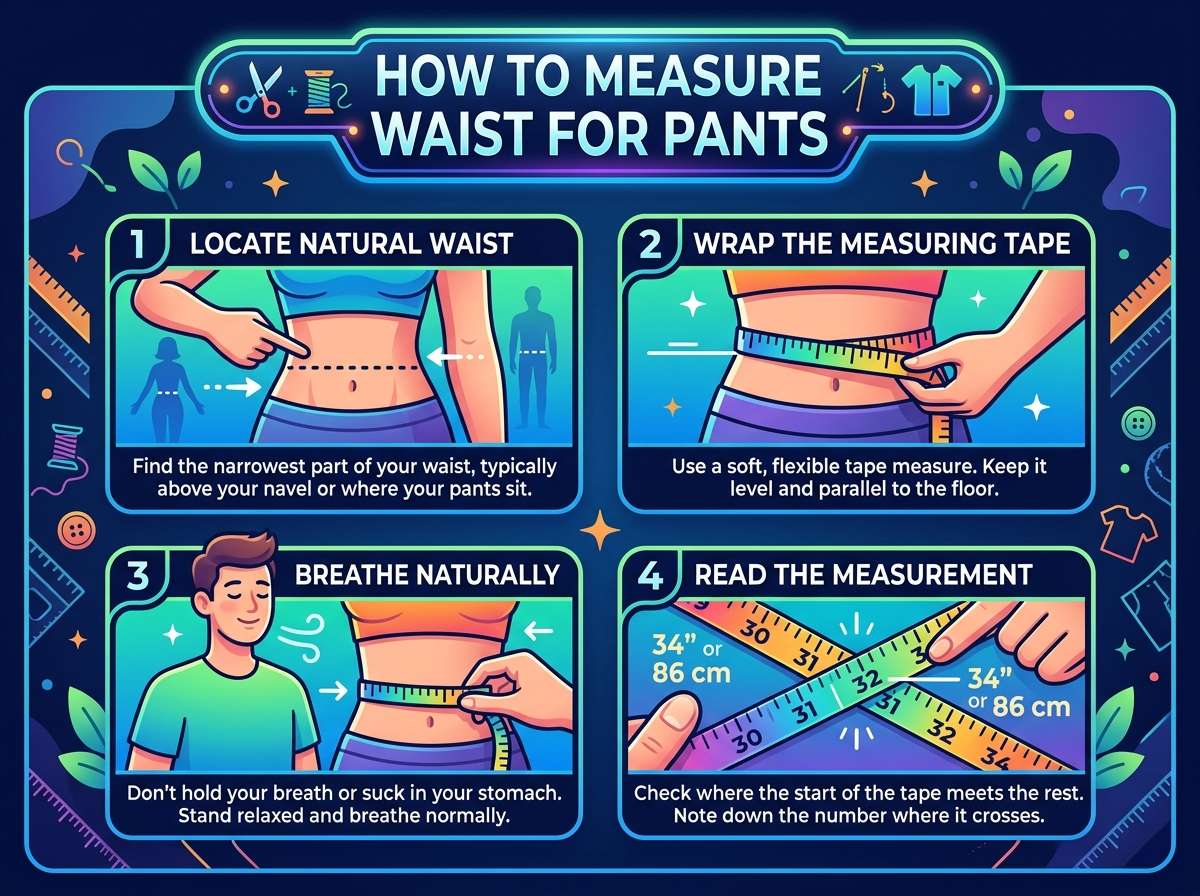
Relax your belly. Don’t suck in your stomach. Don’t push it out either. This is the biggest mistake people make. They hold their breath and pull everything in tight. Then they get a measurement that doesn’t match reality. When you actually wear pants, your belly isn’t sucked in for eight hours. So why measure it that way?
Breathe normally. Take a few calm breaths before you measure. Let your stomach settle into its regular state. This is your true waist size.
Stand with your feet about shoulder-width apart. Keep your weight balanced on both legs. Don’t lean to one side. Don’t shift your weight forward or backward. Think about how you naturally stand while waiting in line at a store.
Wear the clothes you’ll be taking off for the measurement. That way your body is in its actual state. If you plan to wear undershirts under pants, you might wear a thin one now. If you usually wear nothing under pants, then go bare. This prep step ensures the measurement reflects reality.
The Step-by-Step Measuring Process
Now comes the actual measuring. This is where you get the real number.
Step One: Find Your Natural Waist
Your natural waist isn’t the same place as your pants waist. Your natural waist is the smallest part of your midsection. Bend to one side slightly. You’ll see a crease form on your side. That’s roughly where your natural waist is. Bend to the other side and notice the same thing. Find the spot that feels like the narrowest point all the way around.
Some people find this by putting their hands on their sides. Slide your hands up and down until you feel the narrowest area. That’s your natural waist. Mark this spot mentally or with a finger.
Step Two: Wrap the Tape Around
Take your measuring tape and wrap it around your waist at that natural waist point. The tape should be snug but not tight. You should be able to fit one finger between the tape and your body. Not two fingers. Not a whole hand. Just one finger with a little wiggle room.
This is crucial. If the tape is too tight, you’ll get a smaller number than your real size. If it’s too loose, you’ll get a bigger number. That one-finger rule is the sweet spot. It feels snug but comfortable.
Make sure the tape is level all the way around. It shouldn’t dip lower in the front or back. It shouldn’t twist at any angle. Imagine the tape going straight around your body in a perfect circle. Level and even is the goal.
Step Three: Read the Number
Look at where the measuring tape overlaps or meets. The number you see is your waist measurement. Read it carefully. Is it at 30 inches? 32 inches? 35 inches? Write down the exact number you see.
If the number falls between two marks, round to the nearest half inch. If you’re between 32 and 33, measure again to be sure. Try to be as precise as possible. That half inch can make a difference in fit.
Step Four: Measure Again to Confirm
Take the tape off and wrap it around one more time. This confirms your first reading. You want to get the same number twice. If the second measurement differs by more than half an inch, try a third time.
Most people get consistent results after two measurements. If all three measurements are different, you might be wrapping the tape at slightly different heights. Take your time with the third attempt. Aim for consistency.
Where to Find Your Waist for Different Pant Styles
Here’s something many people don’t know. Different types of pants fit at different points on your body. Your natural waist measurement stays the same. But where you measure for different pants styles might change.
For Regular Jeans and Chinos
These standard pants sit slightly below your natural waist. Maybe an inch or two lower. Most men’s jeans sit at this lower point. When you measure for regular jeans, you can measure at either your natural waist or this slightly lower point. Many people measure at their natural waist for jeans too. The difference is usually less than an inch. Check your current jeans to see where they normally sit on your body.
For High-Waisted Pants
High-waisted styles sit right at your natural waist. Sometimes even a tiny bit above. When buying high-waisted pants, measure right at your natural waist. Don’t measure lower. High-waisted pants have a different fit, and measuring at the right spot helps you get the right size.
For Low-Rise Jeans
These sit much lower than natural. They’re positioned around your hips. This is a less common style now, but people still buy them. Measuring at your hips works better for low-rise. Your hip measurement is typically one to two inches larger than your waist. Knowing both numbers helps when buying low-rise styles.
For Work Pants and Dress Pants
Formal pants usually sit at or slightly below your natural waist. Measure at the natural waist point. Work pants tend to be cut a bit looser than jeans. A proper fit leaves room for sitting and moving. Your natural waist measurement guides you well for these styles.
Understanding Vanity Sizing and Brand Differences
Here’s something frustrating but true. A size 32 from one brand doesn’t always match a size 32 from another brand. This is called vanity sizing. Brands use different measurement standards. Some run bigger. Some run smaller. Some are just weird about sizing.
This is exactly why your personal waist measurement matters so much. When you know you have a 34-inch waist, you can handle brand differences. You try on a pair of jeans. You measure them if needed. You adjust your selection based on actual measurements, not just the label size.
High-end brands often use stricter sizing. Budget brands tend to run bigger. Fast fashion chains vary wildly. Online-only brands make up their own rules. None of this matters when you know your true measurement. You’re not guessing. You’re working from facts.
Keep a record of your measurement. Write it down or take a photo of your measuring tape. Show it on your phone when you shop. This helps you navigate any brand quickly. You might find that you wear a 32 at Brand A and a 34 at Brand B. With your waist measurement, you understand why.
How to Measure Existing Pants That Fit Well
Sometimes your best reference is pants you already love. These pants fit great. They feel comfortable. You want to find more like them.
Lay the pants flat on a table. Stretch them out so they’re not bunched up. Find the waistband. Grab it at both side seams. Pull it gently so it’s stretched to its natural width.
Measure across the front of the waistband from one side seam to the other. Don’t include the zipper or button. Just the waistband material. Multiply that number by two. That gives you the full waist circumference.
For example, if the waistband measures 16 inches across, multiply by two. Your waist size is 32 inches. This method works really well for pants that already fit you perfectly. It removes all guesswork.
Alternatively, measure the entire waistband from one side seam all the way around to the other side seam. This is faster and gives you the full number directly. Either method works.
Common Mistakes People Make When Measuring
Learning from mistakes saves time. Here are the errors most people make.
Mistake One: Measuring Over Clothes
Wearing thick sweaters or layers throws off your measurement. You’re measuring fabric, not your body. Take off the extra layers. Measure your actual waist, not your outfit’s waist.
Mistake Two: Holding Your Breath
People naturally suck in when they’re being measured. It feels weird. But this creates a false number. You can’t hold your breath all day, so why measure that way? Breathe normally. Relax your core.
Mistake Three: Making the Tape Too Tight
Pulling the tape tight squeezes your body down. It gives you a smaller number. You’ll buy pants that are too tight. Then you’re disappointed when they barely fit. The one-finger rule prevents this problem.
Mistake Four: Measuring at the Wrong Height
If you dip the tape lower on one side and higher on the other, you’ll get weird numbers. Keep it level and consistent. Take your time with this part.
Mistake Five: Not Recording the Number
You measured, got a number, and then forgot it by the time you got to the store. Write it down immediately. Better yet, take a photo of the tape showing your number. Text it to yourself. Do something to preserve the information.
Mistake Six: Measuring Just Once
One measurement might be a fluke. Two measurements confirm it. Three measurements show a pattern. Measure at least twice. The numbers should match pretty closely.
What to Do With Your Measurement
Once you have your number, what comes next? How do you use this information?
When you shop in stores, you have a target size. You know exactly what to grab off the rack. You still try things on because fit involves more than waist size. But you start in the right ballpark instead of guessing.
Online shopping gets much easier. You can read the size chart before you buy. Most sites list waist measurements for each size. Match your measurement to their sizing. You make smarter choices. Returns drop dramatically.
Keep your measurement somewhere accessible. A note in your phone. A record on your computer. A piece of paper in your wallet. When you shop, reference it. When you try new brands, check how they size things. Over time, you’ll learn which brands work for your body.
Your measurement can change. Weight fluctuates. Bodies change. Check your measurement every few months or whenever you notice a difference. Don’t just assume you’re the same size forever. Take a quick two-minute measurement every so often.
Measuring Tips for Tricky Situations
Some situations make measuring harder than usual.
If You Carry Weight Differently
Some people carry weight all in their belly. Others distribute it around their hips and thighs equally. This doesn’t matter for measuring. You’re measuring at your natural waist, the narrowest point. That point exists regardless of how your body is shaped.
If You’re Between Sizes
Sometimes you fall right in the middle. You’re a 33-inch waist, but most brands only make 32 and 34. Try both. See which feels better when you wear them. Jeans stretch slightly over time, so a 32 might work fine. Dress pants shouldn’t stretch, so a 34 might be smarter. The context matters.
If You Have a Condition Like Bloating
If you experience bloating that changes your size significantly, measure at a consistent time. Morning often works best before you’ve eaten and bloated. This captures your most typical size.
If You Measure Yourself vs. Having Help
Some people struggle with measuring themselves accurately. Having a friend help makes it easier. They can make sure the tape is level and snug. You stay still and relaxed. This removes variables. It’s like having a professional tailor do it. The results are usually cleaner.
How Professional Measurements Compare
Tailors and professional fitters measure differently than you might. They use the same basic method. But they have experience and training. They know the exact spots to measure. They understand how different fabrics and styles work.
You don’t need to go to a professional for basic measuring. The method in this guide works great. But if you’re buying really expensive items or getting custom work done, a tailor’s measurement might help. They can also advise on fit for your specific body type.
For everyday pants shopping, you have everything you need right now. Your own two minutes of measurement beats guessing every time.
Why This Skill Pays Off Long-Term
Learning to measure yourself is an investment. It takes two minutes now. But it saves hours of shopping frustration later. It prevents closet full of ill-fitting pants. It saves money on returns and exchanges. It builds your confidence when buying clothes.
You stop blaming yourself for sizing issues. The problem was never you. You just didn’t know your size. Now you do. That changes everything.
You’ll also get better at spotting fit problems. You’ll know right away if pants are cut weirdly. You’ll understand whether a style is just not made for your body type. You’ll make faster decisions. Shopping becomes less stressful.
Putting It All Together: Your Action Plan
Ready to measure? Here’s what to do right now.
Find your soft measuring tape. If you don’t have one, grab one next time you’re at a store. They cost almost nothing.
Clear about ten minutes. You need the time to relax your body and get a proper measurement. Rushing gives worse results.
Put on comfortable, loose clothing that you can move around in. Something you can easily access your waist area in.
Find a mirror. Stand in front of it. Think about your natural posture.
Locate your natural waist by bending slightly at the sides. Feel for the narrowest point.
Wrap your measuring tape around that spot. Make sure it’s level and snug with one finger fitting between tape and skin.
Read the number carefully. Write it down immediately.
Take the measurement one more time to confirm.
Celebrate. You now know your waist size. You’re ready to buy pants that fit.
Conclusion: You’ve Got This
Measuring your waist sounds like it should be complicated. It’s not. You’ve got all the skills you need right now. You’ve got all the tools at home. You just need a little guidance, which you now have.
The best part? Once you know your waist size, everything gets easier. Shopping for pants stops being a guessing game. You gain control. You make better choices. You end up with clothes that actually fit your body well.
So go ahead. Find that measuring tape. Take the two minutes. Get your number. Then use it every time you shop. Your future self will thank you. Pants that fit well improve your entire day. They boost your confidence. They feel great. It all starts with knowing your waist measurement.
This simple skill makes a real difference. Start measuring today.