How to Use a Diffuser?
So you just got a diffuser. Or maybe you’ve had one sitting on a shelf for a while and you’re not sure where to start. Either way, you’re in the right place.
Using a diffuser is one of the easiest ways to make your home smell amazing, feel calm, and even help you sleep better. And the good news? It’s way simpler than most people think.
This guide walks you through everything — from filling it up for the first time to picking the best essential oils for your mood. Let’s get into it.
What Is a Diffuser, Exactly?
A diffuser is a small device that spreads essential oils into the air. It breaks the oil into tiny particles and mixes them with water vapor. That mist fills your room with scent and the natural benefits of the oil.
There are a few different types of diffusers out there. The most common one is an ultrasonic diffuser. It uses water and vibrations to create a cool mist. It’s quiet, affordable, and perfect for beginners.
Other types include:
- Nebulizing diffusers — These don’t use water. They push pure essential oil straight into the air. They’re more intense and work fast.
- Heat diffusers — These warm the oil to release the scent. They’re simple but heat can change the quality of some oils.
- Evaporative diffusers — These use a fan to blow air through a pad or filter soaked in oil.
For this guide, we’ll focus on the ultrasonic diffuser since it’s the one most people own or start with.
What You Need Before You Start
Before you turn anything on, make sure you have these basics:
- Your diffuser
- Clean, room-temperature water (tap water works, but filtered is better)
- At least one essential oil
- A clean cloth or tissue
That’s really it. You don’t need anything fancy to get started.
Step-by-Step: How to Use a Diffuser
Step 1 — Find the Right Spot
Place your diffuser on a flat, stable surface. Keep it away from the edge of a table or shelf so it doesn’t get knocked over.
Put it somewhere central in the room. This helps the mist spread evenly. Avoid placing it directly on wood furniture without something underneath it — water vapor can damage surfaces over time.
Also keep it away from electronics, books, and anything that doesn’t like moisture.
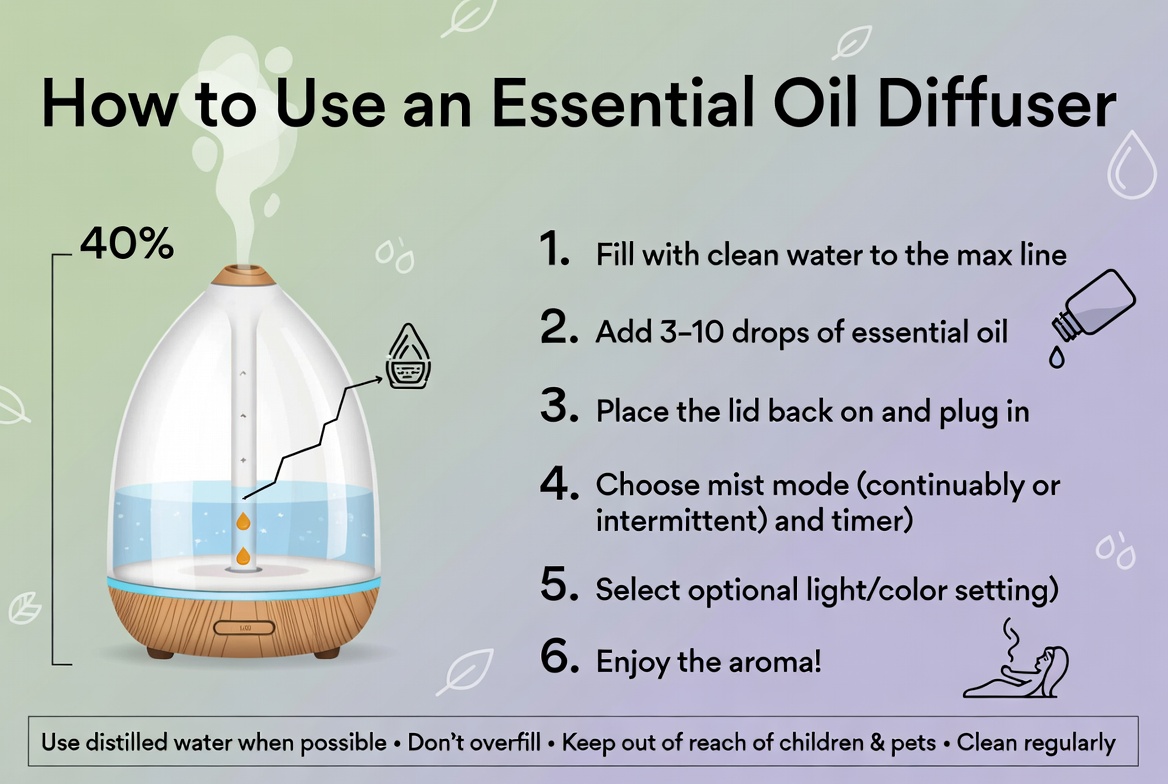
Step 2 — Fill It with Water
Take off the lid or top cover of your diffuser. You’ll see a water tank inside.
Fill it with water up to the line marked inside the tank. This line is called the max fill line. Don’t go past it. Too much water can stop the diffuser from working properly.
Use room-temperature water. Cold water makes it harder for the diffuser to produce mist. Hot water can damage the internal parts.
Step 3 — Add Your Essential Oils
Now for the fun part — the oils.
Add 3 to 5 drops of your chosen essential oil directly into the water. You can use one oil or mix two or three together.
That’s all you need. You don’t need a lot. Essential oils are concentrated and just a few drops go a long way.
If it’s your first time, start with just 3 drops. See how the scent feels in the room. You can always add more next time.
Step 4 — Put the Lid Back On
Place the lid or cover back on the water tank. Make sure it’s secure. Some diffusers have a separate top piece that clips on. Check that it sits properly.
Step 5 — Plug It In and Turn It On
Plug in the power cord. Press the power button.
Most diffusers have a few settings. You might see options for:
- Continuous mist — The diffuser runs non-stop until the water runs out
- Intermittent mist — It runs for a bit, then pauses, then runs again. This saves water and oil and makes the scent last longer
- Timer — You can set it to run for 1 hour, 3 hours, or more
Start with a 1-hour session. See how the scent fills the room and adjust from there.
Some diffusers also have lights built in. You can usually turn the light on or off, or cycle through colors. That part is totally up to you.
Step 6 — Let It Run
Now just let it do its thing. The diffuser will start producing mist within a minute or two.
The mist rises into the air and the scent spreads through the room. Depending on the size of your space, you might notice the smell within a few minutes.
Stay nearby for the first few sessions. Make sure the mist is coming out well and that the diffuser sounds normal — a quiet humming is fine.
How to Clean Your Diffuser
This part is super important and a lot of people skip it.
If you don’t clean your diffuser regularly, old oil builds up inside. That can make future scents smell off, clog the device, and even grow mold.
Clean your diffuser after every few uses. Here’s how:
- Unplug the diffuser and let it cool down
- Pour out any leftover water from the tank
- Dip a cotton ball or soft cloth in rubbing alcohol (isopropyl alcohol works great)
- Wipe the inside of the water tank gently
- Use a cotton swab to clean around the ultrasonic disc — that’s the small metal disc at the bottom of the tank
- Rinse the tank with clean water
- Wipe it dry with a soft cloth
- Let it air dry before using it again
Do a deeper clean once a week if you use it every day. A clean diffuser works better and lasts longer.
How Many Drops of Essential Oil Should You Use?
This is one of the most common questions beginners ask.
The general rule is 3 to 10 drops depending on:
- The size of your room
- The strength of the oil
- Your personal preference
For a small room like a bedroom, start with 3 to 5 drops. For a larger living room, go up to 7 or 8 drops. In a very large open space, you might use up to 10.
Some oils are stronger than others. Peppermint and eucalyptus, for example, are very potent. You only need a couple of drops. Lavender and chamomile are gentler and you can use a bit more.
Always start with less. You can always add more oil next time.
Best Essential Oils for Beginners
Not sure which oil to try first? Here are some great starting points:
Lavender
Lavender is the most popular essential oil for a reason. It smells clean and floral without being too strong. It’s great for relaxation, stress relief, and helping you sleep. Use it in your bedroom before bed.
Peppermint
Peppermint is fresh, cool, and energizing. It helps you feel alert and focused. Use it in your home office or living room during the day. It can also help with headaches.
Eucalyptus
Eucalyptus has a clean, slightly medicinal scent. It’s popular for supporting clear breathing, especially during cold season. It pairs well with peppermint.
Lemon
Lemon essential oil smells bright and uplifting. It can make a room feel clean and fresh. Great for kitchens or any room that needs a bit of energy.
Tea Tree
Tea tree has a sharp, clean scent. It’s often used for its purifying properties. Good for bathrooms or small enclosed spaces.
Sweet Orange
Sweet orange is warm, cheerful, and comforting. It’s a crowd-pleaser and works well in living rooms and common areas. It also blends beautifully with other oils.
Fun Essential Oil Blends to Try
Once you get the hang of using single oils, try mixing a few together. Here are some easy blends:
Relaxing blend:
- 3 drops lavender
- 2 drops chamomile
- 1 drop frankincense
Focus blend:
- 3 drops peppermint
- 2 drops rosemary
- 1 drop lemon
Fresh air blend:
- 3 drops eucalyptus
- 2 drops tea tree
- 2 drops lemon
Happy home blend:
- 3 drops sweet orange
- 2 drops bergamot
- 1 drop ylang ylang
Just add all the drops directly into the water before turning on the diffuser. Play around with ratios until you find what you love.
How Long Should You Run Your Diffuser?
A lot of beginners leave the diffuser running for hours on end. But that’s not always the best idea.
Most aromatherapy experts suggest running a diffuser for 30 to 60 minutes at a time, then taking a break. This lets your nose rest and keeps the scent from becoming overwhelming.
If you want more continuous diffusion, try an intermittent setting. It runs for 30 seconds, then pauses for 30 seconds. This stretches out your water and oil while keeping the scent consistent.
For sleep, run the diffuser for about an hour before bed. You don’t need it going all night. Your room will already be infused with the scent by the time you fall asleep.
Diffuser Safety Tips You Need to Know
Using a diffuser is safe for most people. But there are a few things to keep in mind.
Keep it out of reach of kids and pets. Essential oils can be irritating or even toxic to animals — especially cats. If you have pets, do your research on which oils are safe around them. Keep the diffuser in a room your pet doesn’t spend a lot of time in, or use pet-safe oils only.
Don’t use it for too long in a small space. Good ventilation matters. Open a window sometimes, especially if the room is very small.
Use only pure essential oils. Avoid fragrance oils or synthetic scents. These are not the same as pure essential oils and can damage your diffuser over time.
Don’t add anything other than water and essential oils. No perfume, no carrier oils, no random scented liquids. Just water and pure essential oil.
Pregnant women should check with a doctor first. Some essential oils are not recommended during pregnancy. Lavender is generally considered safe, but always check with a healthcare professional first.
Common Diffuser Problems and Easy Fixes
The diffuser isn’t producing mist
- Check if the water is below the max fill line — refill if needed
- Clean the ultrasonic disc with a cotton swab
- Make sure the device is on a flat surface
- Try distilled water instead of tap water
The mist is weak
- The ultrasonic disc might need cleaning
- The room might be too dry — try running it in a smaller space first
- You may be in a very large room that needs a more powerful diffuser
The scent is too strong
- Use fewer drops next time
- Run it on intermittent mode
- Open a window slightly
The scent disappears quickly
- You might have become nose-blind (your nose gets used to a smell)
- Leave the room for a few minutes and come back — you’ll smell it again
- Try a different oil or blend
The diffuser makes a gurgling noise
- You probably filled it above the max line — pour some water out
How to Store Your Diffuser
If you’re not planning to use it for a while, store it properly.
Empty the water tank completely. Clean it out. Let it air dry. Then store it in a cool, dry place away from direct sunlight.
Store your essential oils the same way — in a dark, cool spot. Heat and sunlight break down the compounds in the oil and make them less effective.
How to Pick the Right Diffuser
If you’re still shopping or thinking about getting a second one, here are some things to look for:
Tank size — A bigger tank means longer run time between refills. A 300ml tank runs for about 6 to 8 hours. A 100ml tank lasts about 3 to 4 hours.
Noise level — Most ultrasonic diffusers are quiet. But some are quieter than others. If you want it in your bedroom, look for one marketed as “whisper quiet.”
Timer settings — Look for one with at least a 1-hour and 3-hour timer option. Intermittent mode is a bonus.
Coverage area — Most diffusers list the square footage they cover. Match this to your room size.
LED light — Optional but nice. Some people love the soft glow. Others want it to be completely dark while sleeping. Look for one with the option to turn the light off.
Making Diffusing Part of Your Routine
Once you get comfortable with your diffuser, it can become a really enjoyable daily habit.
A lot of people use aromatherapy as a signal for their body and mind. Diffusing lavender every night before bed tells your brain it’s time to wind down. Diffusing peppermint in the morning becomes a wake-up ritual. It’s a simple form of sensory anchoring.
Try pairing it with other calming activities — reading, journaling, stretching, or meditating. The scent in the air adds another layer to the experience.
You can also match your oil to the season. Use warming scents like cinnamon and clove when it’s cold. Go for fresh citrus and minty oils in warm weather.
Quick Recap: How to Use a Diffuser in 6 Steps
Just in case you want a fast reference:
- Place the diffuser on a flat, stable surface
- Fill the water tank up to the max fill line with clean water
- Add 3 to 5 drops of your chosen essential oil
- Put the lid back on securely
- Plug it in and press the power button
- Choose your settings and let it run
Clean it every few uses and you’re all set.
Final Thoughts
Using a diffuser is one of those small things that can make a real difference in how your home feels. It’s relaxing, it’s fun, and once you start experimenting with different oils and blends, it becomes something you genuinely look forward to.
Start simple. Use lavender or sweet orange for your first session. See how the scent makes you feel. Then slowly explore from there.
You don’t need to be an aromatherapy expert to enjoy the benefits. Just fill it up, drop in some oil, and breathe.
That’s it. You’ve got this.
Want to explore more about essential oil blends, aromatherapy benefits, or diffuser types? Keep experimenting — the best part is making it your own.
Mary is a fashion enthusiast and lifestyle writer who loves discovering stylish clothing, accessories, and everyday fashion essentials. She enjoys researching the latest trends, reviewing popular products, and sharing practical style tips to help readers dress with confidence. Through FashionSolve.com, Mary provides honest recommendations, fashion guides, and inspiration for building a wardrobe that is both stylish and affordable.