How to Know Your Undertone?
You’ve probably heard the term “undertone” thrown around when talking about makeup, fashion, or skincare. But what does it actually mean, and why should you care about it? The truth is, knowing your undertone can change how you look in colors and help you make better choices about makeup shades, clothing colors, and even jewelry. Let me break this down in the simplest way possible.
What Are Undertones Anyway?
Think of your skin tone like a base coat of paint on a wall. Now, undertones are like the subtle tint mixed into that paint. They’re the colors hiding beneath your skin’s surface that you can’t always see at first glance.
Everyone has an undertone, no matter what your skin color is. Light skin, dark skin, olive skin—all of it has undertones. These aren’t colors you see on the surface. They’re the deeper hues that show through your skin and affect which colors look good on you.
Your undertone comes from the mix of colors in your blood vessels and the pigments in your skin. It’s something you’re born with, and it stays pretty much the same throughout your life, even if your skin tone gets darker or lighter from the sun.
The Main Undertone Categories
There are three main undertone types: warm, cool, and neutral. Let’s explore each one so you can figure out where you belong.
Warm Undertones
Warm undertones have golden, peachy, or yellow hues. People with warm undertones often look like they have a golden glow. Think of warm undertones as the sunny side of the color spectrum.
If you have warm undertones, you might notice that:
- Gold jewelry looks more flattering on you than silver
- Warm colors like oranges, warm reds, and golden yellows make you look vibrant
- Your veins might appear greenish or olive-tinted
- Warm, earthy tones in makeup shade look natural on you
- Peach blush shades work better than pink ones
Warm skin undertones work well with colors that have golden or yellow bases. These could be warm copper tones, burnt orange, terracotta, warm browns, and golden tones in general.
Cool Undertones
Cool undertones have pink, red, or blue hues running through your skin. If you have cool undertones, think of yourself as living on the cooler side of the color wheel.
People with cool undertones often see that:
- Silver jewelry flatters them more than gold
- Pink, red, and jewel-tone colors make them glow
- Their veins appear more blue or purple
- Pink blush shades feel more natural
- Cool, rosy makeup tones suit them best
Cool skin undertones look amazing in colors with blue or pink bases. Rose gold, cool reds, jewel tones like emerald and sapphire, and cool pinks all work beautifully.
Neutral Undertones
Neutral undertones don’t lean heavily toward warm or cool. You have a good balance of both. Neutral undertones are like the middle ground—you might look good in both warm and cool colors.
If you have neutral undertones, you might find that:
- Both gold and silver jewelry can look good on you
- You can pull off warm and cool colors relatively easily
- Your veins might be a mix of colors or hard to categorize
- You have flexibility with makeup shades
- You might not feel like you fit clearly into warm or cool
Neutral undertones are pretty flexible. You can often rock colors from both the warm and cool sides of the spectrum.
Easy Tests to Find Your Undertone
Now that you know the types, let’s figure out which one you are. Here are some simple tests you can try at home.
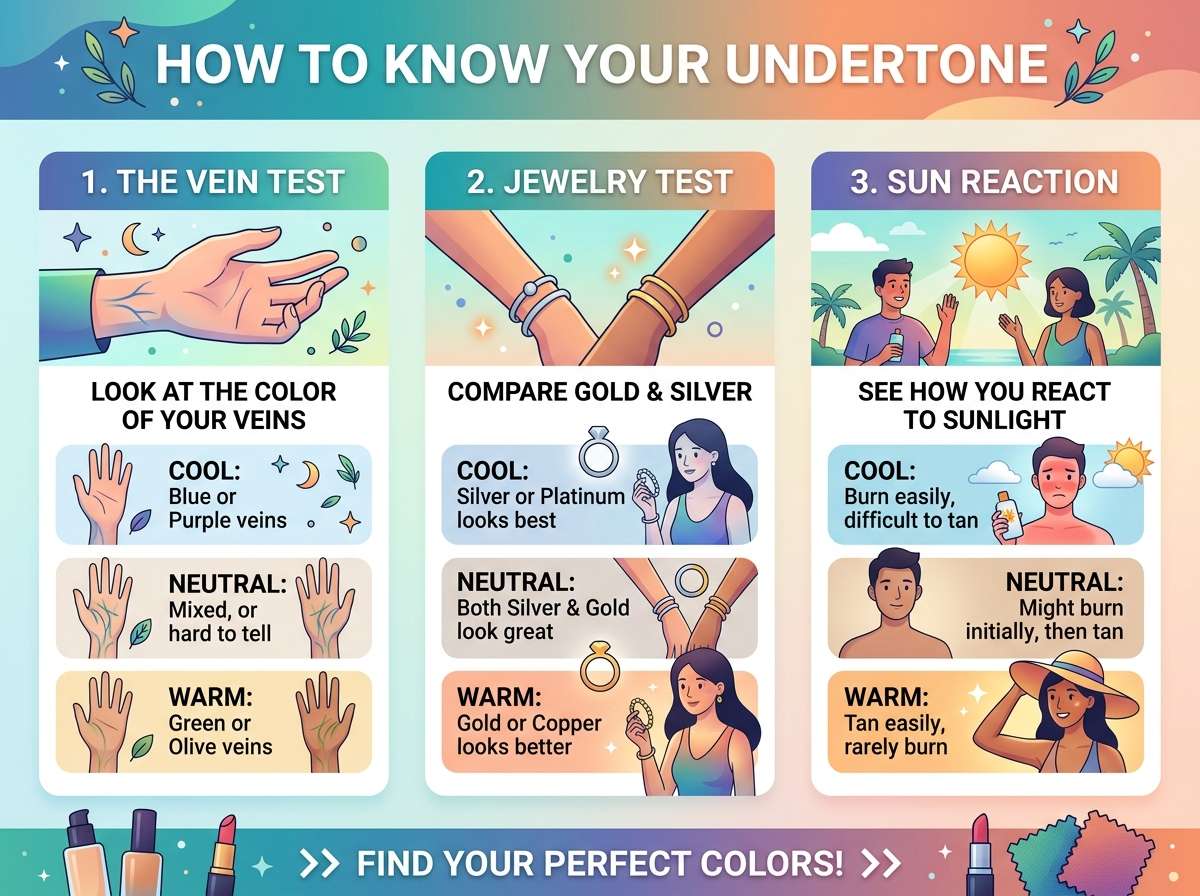
The Vein Test
This is the easiest starting point. Look at the veins on your wrist under natural light.
Do your veins look greenish or olive? You probably have warm undertones. Green veins mean more gold is showing through your skin.
Do your veins look blue or purple? You likely have cool undertones. Blue veins mean the cooler pigments are more visible.
Do your veins look like a mix of both blue and green? You might have neutral undertones.
Keep in mind that this test works best for most people, but not everyone. Some people have multiple vein colors, so don’t stress if this test feels unclear.
The Jewelry Test
Grab some gold and silver jewelry. Put them on your skin (or just hold them up to your wrist or neck) and see which one looks better.
Does gold make your skin look brighter and healthier? Gold jewelry usually flatters warm undertones best. Gold has that warm, yellow quality that complements golden skin.
Does silver make your skin glow more? Silver usually works better for cool undertones. Silver has cooler, neutral tones that bring out pink and rosy skin.
Do both look equally good? You might have neutral undertones that work with either metal.
The Color Draping Test
Grab some fabric or clothing in different colors. The easiest colors to test are white, black, bright pink, and warm orange.
Hold white fabric near your face. Does it make you look washed out or tired? Or does it make you look fresh and healthy?
Try black next. Again, notice if it makes you look energized or dull.
Now hold bright pink near your face. This is a cool color. Does your face look like it glows, or does the color fight with your skin?
Try a warm orange shade. Does this feel more natural on you?
Pay attention to how your skin looks next to these colors. If you look better in bright pink and black, you probably have cool undertones. If you look better in warm orange and cream, you likely have warm undertones.
The White Paper Test
This test is super simple. Hold a piece of white paper next to your face in natural light (not fluorescent light).
Look at how your skin looks against the pure white. Does your skin look peachy or golden next to it? That points to warm undertones.
Does your skin look pink or rosy? That suggests cool undertones.
Does your skin just look like its normal color without any obvious warm or cool contrast? You might be neutral.
How Your Undertone Affects Makeup Choices
Once you know your undertone, you can use this info to pick makeup that actually works with your skin rather than against it.
Foundation and Concealer
If you have warm undertones, look for foundations with warm or golden undertones. Avoid shades that lean too pink or ashy.
If you have cool undertones, pick foundations with pink or rosy undertones. Stay away from shades that look too orange or yellow.
If you have neutral undertones, you can usually pull off either, but you might look best in truly neutral shades.
Blush and Bronzer
Warm undertone lovers should reach for peachy, warm pink, and bronze shades. These colors work with your natural coloring rather than against it.
Cool undertone people should grab rosy pinks, berry shades, and cool bronzers. Skip the overly orange or peachy shades.
Neutral undertone folks can experiment with both warm and cool blush shades to find what feels best.
Eyeshadow and Eyeliner
Warm undertones shine with warm golds, bronzes, warm browns, and terracotta shades. Warm eyeliner colors like bronze and gold work beautifully.
Cool undertones look amazing in silvers, cool taupes, cool pinks, and jewel tones. Cool eyeliner shades like deep blue and plum flatter cool skin.
Neutral undertones have freedom to play with all eyeshadow colors. Your flexibility is one of the best parts of being neutral!
How Your Undertone Affects Your Wardrobe
Your undertone doesn’t just matter for makeup. It affects which clothing colors actually look good on you too.
Warm Undertone Fashion
If you have warm undertones, you’ll look best in warm colors and earth tones. This includes warm reds, oranges, warm yellows, golds, terracotta, rust, warm browns, and olive greens.
Colors like true white, black, and bright cool colors might make you look a bit washed out, but you can still wear them if you pair them with warmer accent colors.
Warm colored clothing makes your skin look vibrant and healthy. When you wear colors that match your undertone, you don’t need as much makeup because your skin naturally looks its best.
Cool Undertone Fashion
If you have cool undertones, cool colors are your friends. This includes cool reds, pinks, purples, blues, jewel tones, and cool greens.
Cream and pure white work on you in a way they might not for warm undertone people. Your skin keeps its rosy glow next to these neutral shades.
Warm earthy tones can look a little off on you, but you can still wear them with cool colored accessories to balance the outfit.
When you wear cool colors, your skin tone stands out and looks healthier without a lot of effort.
Neutral Undertone Fashion
If you’re neutral, you basically get to wear whatever colors you like. Both warm and cool colors work on you. This is actually a huge advantage.
You have way more color options than warm or cool undertone people. Your flexibility with color is something to celebrate.
The Undertone Myth Everyone Gets Wrong
Let me clear up something important: undertone is different from skin tone. Your skin tone is how light or dark your skin is. Your undertone is the color beneath the surface. These are two completely separate things.
You can be dark skinned with cool undertones. You can be pale with warm undertones. Undertone and skin tone don’t always match what people might assume, and that’s totally normal.
This means that two people with the same skin tone might have completely different undertones and look best in totally different colors. Never assume someone’s undertone based on how dark or light their skin is.
What About Olive Undertones?
Olive is actually a mix of warm and cool undertones. Olive undertones have greenish or golden-green tints. If you have olive undertones, you might feel like you don’t quite fit into the warm or cool categories.
If you’re olive, try out colors from both warm and cool palettes and see what feels right. Many olive undertone people find that certain jewel tones and golden earth tones work particularly well.
Olive undertones are common in many skin tones and ethnicities. If you think you might be olive, don’t stress about fitting perfectly into the warm or cool box.
Finding Your Perfect Shade in Every Product
Once you know your undertone, shopping for makeup and clothes becomes so much easier. Here’s how to apply this knowledge at the store or when shopping online.
Reading Makeup Product Names
Makeup companies often use words like “warm,” “cool,” “neutral,” “golden,” “rosy,” and “natural” in their product names. These words tell you the undertone of the product.
If a foundation says “warm,” it has warm undertones. If it says “cool” or “rosy,” it has cool undertones. If it says “neutral,” it’s meant to work for multiple undertones.
Getting used to reading these labels takes a little practice, but once you do, you’ll never buy the wrong shade again.
Swatching Products
When you do buy in person, always swatch products on your jawline or cheekbone in natural light. This shows you how the color actually looks on you.
A product that looks one way in the bottle might look completely different on your skin. This is why swatching matters so much.
Take your time with swatching. Step outside or go near a window to see how the color looks in natural light, not just under store lighting.
Testing Before You Commit
If you’re buying makeup online, look for products with good return policies. You want to be able to try things and send them back if they don’t work.
Read reviews from people with similar undertones to you. If they mention that a product has warm or cool undertones, you know whether it will work for you.
Your Undertone Might Feel Different on Different Days
Here’s something interesting: your undertone stays the same, but it might look different depending on what you’re wearing, your lighting, or even how much sun you’ve been in.
If you spend time in the sun, your skin gets darker, but your undertone stays the same. A warm undertone person who tans still has warm undertones.
Lighting changes how you perceive colors too. Warm lighting makes everything look warmer, and cool lighting makes everything look cooler. This is why natural light is always best for testing.
Don’t get confused if your undertone looks different under store lights versus natural light. Trust the results from natural light testing.
Common Mistakes People Make
Let me point out some common mix-ups so you don’t fall into the same traps.
Mistake One: Confusing Your Undertone with Your Skin Tone
Your undertone is not the same as whether your skin is light, medium, or dark. These are different things. Focus on the undertone specifically.
Mistake Two: Assuming You Know Your Undertone Without Testing
Don’t guess your undertone based on how you think you should look. Actually do the tests. Your undertone might surprise you.
Mistake Three: Thinking You Can Only Wear One Color Family
You can wear colors outside your undertone family. It just might take more effort with makeup or accessories to balance the look. Don’t feel trapped by your undertone.
Mistake Four: Forgetting That Some Shades Are Flexible
Some colors work for everyone. True black, true white, and some jewel tones can look good on warm, cool, and neutral undertones depending on how they’re styled.
How to Use This Knowledge Going Forward
Now that you know your undertone, here’s what to do with this info:
Start paying attention to which colors you naturally reach for and which ones make you feel best. You’ll probably notice a pattern.
When you’re shopping for clothes or makeup, check the undertone of the product. Does it match your undertone? Great, go for it.
Don’t be afraid to experiment. Your undertone is a guideline, not a prison. If you want to wear a color that’s not “your” undertone, wear it. Pair it with accessories and makeup in your actual undertone, and you’ll make it work.
Share your undertone knowledge with friends. Help them figure out their undertones too. Once you start seeing undertones everywhere, you can’t unsee them.
The Bottom Line
Your undertone is the secret color hiding beneath your skin that affects which shades look best on you. Finding your undertone takes just a few simple tests: the vein test, the jewelry test, the color draping test, or the white paper test.
Once you know whether you have warm, cool, neutral, or olive undertones, you can use this knowledge to pick better makeup, choose more flattering clothes, and feel more confident in how you look.
The best part? This is free information that nobody can take away from you. It’s one of the easiest beauty hacks that actually works.
So try out those tests today. Look at your veins. Hold up some jewelry. Drape some colors near your face. Figure out your undertone and start making smarter choices about the colors you wear and the makeup you buy.
You’ve got this. And once you know your undertone, you’ll wonder how you ever got by without this knowledge.
Want to keep learning about how to look your best? Understanding your undertone is just the first step. Keep exploring what works for your unique skin, hair, and style. Every person is different, and that’s what makes finding your perfect colors so fun.
Mary is a fashion enthusiast and lifestyle writer who loves discovering stylish clothing, accessories, and everyday fashion essentials. She enjoys researching the latest trends, reviewing popular products, and sharing practical style tips to help readers dress with confidence. Through FashionSolve.com, Mary provides honest recommendations, fashion guides, and inspiration for building a wardrobe that is both stylish and affordable.